
Introduction
Zinc oxide (ZnO) appears deceptively simple as a chemical formula, but sourcing the right grade for your application can determine product performance, regulatory compliance, and production continuity. In 2026, the global zinc oxide market spans approximately 1.8-2.1 million metric tons annually, valued at THB 85-100 billion, with prices fluctuating between THB 90,000-162,000 per metric ton depending on grade and region.
Manufacturers across rubber, ceramics, cosmetics, pharmaceuticals, and electronics face a critical decision: commodity suppliers offer lower prices but wider specification windows, while specialty producers deliver tighter tolerances at premium costs. The wrong choice risks out-of-spec batches, production downtime, regulatory violations, and costly reformulations.
Post-pandemic supply chain disruptions and tightened environmental enforcement in China and the EU have reshaped production geography, with Southeast Asia and Eastern Europe gaining capacity. Sustainability requirements such as carbon intensity, wastewater treatment, traceability, now factor into supplier selection alongside price and quality.
This guide provides a structured, evidence-based framework for evaluating zinc oxide suppliers, from defining technical specifications through contract negotiation. We cover supplier types, quality tiers, manufacturing processes, audit protocols, pricing structures, logistics considerations, and regulatory requirements so you can select suppliers that match your quality needs and business rhythm.
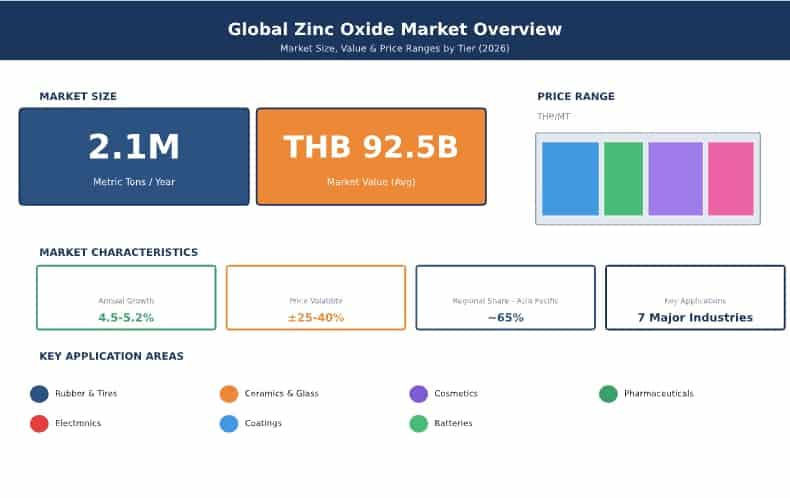
Understanding Zinc Oxide: Applications Drive Requirements
Zinc oxide serves diverse industries, each demanding distinct physical and chemical properties. Application requirements determine which supplier tier fits your needs.
Primary Application Categories
| Industry | Key Requirements | Typical Grade | Critical Parameters |
| Rubber & Tires | Vulcanization activation, reinforcement | Commodity/Industrial | Surface area, moisture <0.5%, particle size 0.3-1.0 μm |
| Ceramics & Glass | Low impurities, consistent sintering | Mid-grade/Reagent | Fe <50 ppm, Pb <20 ppm, Cd <10 ppm |
| Cosmetics & Sunscreens | UV scattering, nano-safety compliance | Specialty/Nano | Particle size D50 30-150 nm, heavy metals <5 ppm |
| Pharmaceuticals | GMP compliance, traceability | Pharma/USP Grade | Microbial limits, endotoxins, full traceability |
| Electronics | High purity, electrical properties | High-Purity/Specialty | 99.99%+ purity, controlled morphology |
| Coatings & Pigments | Dispersion, color consistency | Mid-grade/Functionalized | Surface treatment, bulk density |
| Batteries & Energy | Precursor consistency, low contamination | High-Purity | Transition metal impurities <10 ppm |
Why Application Matching Matters
Rubber manufacturers prioritize surface area and stearic acid conditioning for optimal dispersion during vulcanization. A 10% variation in surface area can shift cure time by 15-30 seconds which is critical in high-speed tire production lines.
Sunscreen formulators require uniform nano-particles with documented safety dossiers. EU Cosmetics Regulation (EC) No 1223/2009 mandates nano-material notification and safety assessment updates every 2-3 years.
Ceramic producers cannot tolerate iron contamination above 50 ppm as it causes discoloration in white frits and glazes. One contaminated batch can scrap entire kiln loads worth THB 1.8-7 million.
Pharmaceutical manufacturers need GMP-certified supply chains with full batch traceability. FDA 21 CFR Part 211 requires validated supplier qualification and certificate of analysis (COA) verification for each lot.
Supplier Types: Know Who You’re Buying From
Understanding supplier categories helps set realistic expectations for flexibility, pricing, and traceability.
Type 1: Integrated Miners/Refiners
Profile: Large firms extracting zinc concentrate and operating smelters producing zinc oxide as primary or co-product.
Advantages:
- Scale pricing (lowest cost per MT)
- Traceable raw-material origin
- Vertically integrated quality systems
- Supply security from mine-to-oxide
Disadvantages:
- Less flexibility on small, bespoke orders
- Lead times tied to large production schedules
- Limited technical support for formulation issues
- MOQs typically 20+ MT
Best for: High-volume rubber compounding, industrial applications, commodity buyers prioritizing cost over customization.
Examples: Hindustan Zinc (India), Nyrstar (EU/US), Yunnan Zinc (China)
Type 2: Specialty Chemical Manufacturers
Profile: Mid-sized to large companies synthesizing zinc oxide to tight tolerances for pharmaceuticals, cosmetics, and electronics.
Advantages:
- Product consistency (Cpk >1.67 on critical parameters)
- Technical support and R&D collaboration
- Regulatory documentation (DMF, CEP, GMP certificates)
- Custom particle sizes and surface treatments
Disadvantages:
- Higher price per kg (30-200% premium vs. commodity)
- Longer lead times for custom grades (8-16 weeks)
- MOQs may still exceed small buyer needs
Best for: Pharmaceuticals, medical devices, cosmetics, electronics, applications requiring regulatory dossiers.
Examples: Umicore (Belgium), Zochem (US), Koko (South Korea)
Type 3: Traders and Toll Processors
Profile: Firms buying bulk zinc oxide, repackaging, blending, and providing local warehousing and just-in-time delivery.
Advantages:
- Flexible MOQs (down to 25-500 kg)
- Faster delivery from local inventory
- Geographic bridging for import-constrained buyers
- Value-added services (blending, custom packaging)
Disadvantages:
- Limited control over upstream quality
- Traceability gaps unless backed by strong audits
- Margin markup (10-25% over direct manufacturer pricing)
- Risk of commingling batches from multiple sources
Best for: Small-to-medium buyers, emergency supply, geographic markets without direct manufacturer presence, pilot-scale production.
Risk mitigation: Require traders to provide upstream manufacturer COAs, conduct audits of both trader and source facilities, and implement incoming QC testing on every lot.
Manufacturing Processes: How Production Method Affects Properties
The manufacturing process significantly influences zinc oxide properties. Match process type to application requirements.
| Process Type | Description | Typical Purity | Key Characteristics | Best Applications |
| Direct (American) Process | Zinc ore/carbothermal reduction in furnace | 95-98% | Lower cost, wider impurity range, larger particles | Rubber, ceramics, industrial |
| Indirect (French) Process | Zinc ingot vaporization and oxidation | 98-99.5% | Higher purity, consistent particle size, higher surface area | Pharmaceuticals, cosmetics, coatings |
| Wet Chemical Synthesis | Precipitation from zinc salts | 99-99.99% | Tightest controls, engineered morphology, nano-capable | Electronics, advanced ceramics, R&D |
| Hydrothermal | High-temperature aqueous synthesis | 99.9%+ | Controlled crystal structure, low agglomeration | Specialty applications, research |
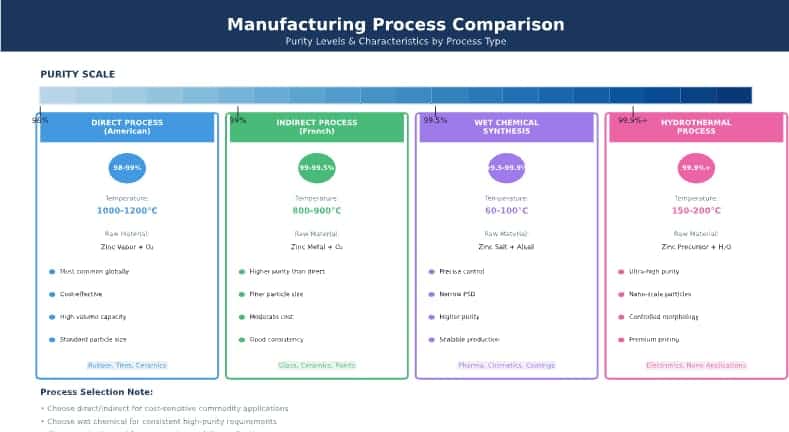
Process-property relationships:
- Indirect process products typically yield higher surface area (10-50 m²/g), beneficial for catalytic activity and rubber vulcanization but potentially problematic for cosmetics requiring low reactivity.
- Direct process materials contain more trace impurities (Pb, Cd, Fe) from ore sources which is acceptable for rubber but disqualifying for pharmaceuticals.
- Wet chemical synthesis enables precise particle size control (including nano-scale) and surface functionalization but at 2-4x commodity pricing.
Due diligence question: Ask suppliers to disclose their primary production process. Traders may not know that this signals traceability gaps.
Quality Tiers: Commodity vs. Reagent vs. Specialty
Understanding quality tiers prevents costly mismatches between your requirements and supplier capabilities.
Commodity Grade (THB 90,000-115,200/MT)
Characteristics:
- Purity: 95-98% ZnO
- Impurity tolerance: Wider specification windows (Fe up to 200-500 ppm)
- Documentation: Basic COA per lot
- Lead time: 2-4 weeks standard
- Minimum order: 10-20 metric tons
Best for: Rubber compounding, industrial coatings, agricultural applications, large-volume users where minor variations don’t impact final product performance.
Risk factors: Lot-to-lot variability can reach 5-8%. Not suitable for regulated applications or products requiring consistent color/optical properties.
Reagent/Pharmaceutical Grade (THB 126,000-198,000/MT)
Characteristics:
- Purity: 99-99.5% ZnO
- Impurity controls: Heavy metals <20-50 ppm, documented per USP/EP standards
- Documentation: Full COA, GMP statements, method validation summaries
- Lead time: 4-8 weeks
- Minimum order: 500 kg – 5 metric tons
Best for: Pharmaceuticals, medical devices, food-contact applications, cosmetics, laboratory reagents.
Risk mitigation: Suppliers maintain retention samples for 2-5 years. Batch traceability extends to raw material sources.
Specialty/Nano Grade (THB 216,000-540,000+/MT)
Characteristics:
- Purity: 99.5-99.99%+ ZnO
- Engineered properties: Controlled particle size, surface coatings, functionalization
- Documentation: Comprehensive technical dossiers, regulatory filings, stability data
- Lead time: 8-16 weeks (custom grades longer)
- Minimum order: 100 kg – 1 metric ton
Best for: Sunscreens (nano ZnO), electronics (varistors, transparent conductors), advanced ceramics, catalytic applications, R&D.
Value proposition: Higher unit cost enables product differentiation, performance advantages, and regulatory compliance in sensitive markets.
The Supplier Selection Framework: 8-Step Evaluation Process
Selecting zinc oxide suppliers requires disciplined, evidence-based evaluation. Use this structured approach to reduce risk and ensure alignment with your technical and commercial requirements.
Step 1: Define Technical Specifications
Translate end-use requirements into measurable parameters before contacting suppliers.
Critical specifications to define:
| Parameter | Testing Method | Typical Range | Application Impact |
| ZnO Assay | Titration/ICP | 95-99.99% | Purity, reactivity |
| Particle Size (D50) | Laser Diffraction | 0.1-5.0 μm (micron); 30-150 nm (nano) | Dispersion, transparency, UV scattering |
| Surface Area (BET) | Gas Adsorption | 1-50 m²/g | Reactivity, cure kinetics |
| Heavy Metals (Pb, Cd, Hg, As) | ICP-MS | <5-50 ppm | Regulatory compliance, color |
| Moisture Content | Loss on Drying | <0.3-1.0% | Flowability, shelf life |
| Bulk Density | Tap Density Test | 0.3-0.8 g/cm³ | Dosing accuracy, handling |
| pH (10% slurry) | pH Meter | 6.0-8.0 | Compatibility, stability |
| Loss on Ignition | Gravimetric | <1-3% | Organic residues, calcination quality |
Red flag: Suppliers unwilling to provide test methods or using only unspecified “in-house” methods without validation data.
Step 2: Request Technical Documentation
Before scheduling visits or trials, request and review:
- Technical Data Sheets (TDS) with complete specification ranges
- Certificates of Analysis (COA) from recent production lots (request 3-5 consecutive lots to assess consistency)
- Safety Data Sheets (SDS) compliant with GHS 2015/OSHA requirements
- Quality Certificates: ISO 9001, ISO 13485 (medical), ISO 14001 (environmental), ISO 45001 (occupational health), GMP statements
- Regulatory Documentation: REACH registration, TSCA compliance, cosmetic nano-notification (if applicable), DMF/CEP (pharmaceuticals)
- Test Method Documentation: Are they using ASTM, ISO, EP, USP, or validated in-house methods?
- Ethical Sourcing: Conflict minerals statements, modern slavery policies (where applicable)
Cross-check: Compare COAs across multiple lots. Standard deviation >5% on key parameters indicates inconsistent production control.
Step 3: Conduct Supplier Audits
On-site or virtual audits reveal capabilities that documents alone cannot verify.
Audit checklist:
| Audit Area | Key Questions | Evidence to Request |
| Raw Material Controls | How are zinc sources qualified? What incoming tests are performed? | Supplier qualification records, incoming inspection logs |
| In-Process Monitoring | What critical control points are tracked? How often? | Process control charts, SPC data |
| Finished Goods Testing | Is every lot tested before release? What’s the retention sample policy? | Release procedures, retention sample inventory |
| Non-Conformance Handling | How are out-of-spec batches handled? What’s the CAPA timeline? | NC logs, corrective action reports |
| Traceability Systems | Can you trace a lot back to raw material batches? | Traceability exercise (request live demonstration) |
| Environmental Controls | How is dust/contamination controlled? Wastewater treatment? | EHS audit reports, air/water monitoring data, environmental permits |
| Capacity & Redundancy | What’s the annual capacity? Backup production options? | Capacity utilization data, contingency plans |
| Labor Practices | Worker safety measures? Modern slavery compliance? | Safety training records, social compliance audits |
Virtual audit protocols: When travel is constrained, require live video walkthroughs of production areas, quality labs, and warehouses. Request screen-sharing of electronic records systems. Verify documents via video rather than accepting emailed copies alone.
Best practice: Schedule audits before initial orders for critical applications. Plan periodic surveillance audits (annual or biennial) for long-term partners.
Step 4: Validate with Trial Lots
Never accept a supplier solely on paper documentation.
Trial protocol:
- Request 3-5 production lots (not special “showcase” batches)
- Run under actual production conditions with your standard formulations
- Measure performance metrics specific to your application:
- Rubber: Cure time (t90), tensile strength, elongation
- Sunscreen: SPF in vitro/in vivo, dispersion stability
- Ceramics: Sintering density, color consistency, thermal expansion
- Electronics: Electrical resistivity, breakdown voltage
- Statistical evaluation: Use at least n=5 replicates per lot. Calculate mean, standard deviation, and process capability (Cpk).
- Accelerated stability testing: 3-6 months at elevated temperature/humidity to predict shelf life.
- Pilot timeline: Plan 2-4 weeks for representative sample testing to spot dispersion or reactivity issues not visible on paper.
Decision criteria: Reject suppliers if lot-to-lot variation exceeds your process tolerance or if Cpk <1.33 on critical parameters.
Step 5: Analyze Total Cost of Ownership
Price per kilogram is only one component. Model total cost of ownership:
Cost components:
| Cost Element | Typical Range | Notes |
| Base Price (per MT) | THB 90,000-540,000+ | Varies by grade, volume, region |
| Freight & Logistics | THB 7,200-28,800/MT | Depends on Incoterms (EXW, FOB, CIF, DDP) |
| Packaging | THB 1,800-7,200/MT | Big bags (1 MT), drums (250 kg), smaller packs premium |
| Import Duties | 0-6.5% | Varies by country, trade agreements |
| Testing & QC | THB 18,000-72,000/lot | Third-party verification if required |
| Inventory Carrying Cost | 15-25% annually | Safety stock, warehousing |
| Risk Costs | Variable | Out-of-spec batches, production downtime, recalls |
Scenario modeling example:
Supplier A: THB 108,000/MT, 4% lot rejection rate, 3-week lead time
Supplier B: THB 122,400/MT, 0.5% lot rejection rate, 6-week lead time
If rejected lots cost THB 540,000 in rework/downtime and you consume 100 MT annually:
- Supplier A total cost: 10,800,000 + (4 lots × 540,000) + inventory = ~THB 13.5 million
- Supplier B total cost: 12,240,000 + (0.5 lots × 540,000) + higher inventory = ~THB 12.8 million
Lower unit price can cost more overall.
Pricing red flags: Beware very low unit prices—they often reflect downgraded specs, hidden logistics costs, or rework expenses downstream.
Step 6: Assess Supply Continuity & Logistics
Zinc oxide supply faces disruption risks from feedstock shortages, plant maintenance, environmental regulations, and logistics bottlenecks.
Verification checklist:
- Production capacity: What’s rated capacity vs. current utilization? (>85% utilization signals potential constraints)
- Raw material security: Do they mine zinc directly or purchase zinc ingot? What’s their supplier diversification?
- Inventory policies: Safety stock levels? Consignment arrangements available? Local warehousing options?
- Export experience: Track record with your country’s customs? Documentation accuracy?
- Lead time reliability: On-time delivery performance (% shipments within agreed window)
- Seasonal variability: Are there monsoon, holiday, or maintenance periods affecting supply?
- Contingency plans: Alternative production sites? Emergency shipment protocols?
Contract protections: Include minimum volume commitments, rolling 12-month forecasts, penalty clauses for late delivery (>5 days), and force majeure definitions with mitigation expectations.
Preferred supplier commitment: Favor suppliers that commit to buffer stock or local warehousing for critical grades.
Step 7: Contractual Quality Guarantees
Contracts must include technical appendices with enforceable quality provisions.
Essential clauses:
| Clause | Purpose | Recommended Language |
| Acceptance Criteria | Define pass/fail standards | “Material shall meet specifications in Appendix A. Third-party lab testing at [named lab] governs disputes.” |
| Sampling Protocol | Specify how lots are tested | “Per ISO 2859-1 Level II, AQL 1.0 for critical parameters.” |
| Non-Conformance Remediation | Define remedies for out-of-spec lots | “Supplier shall replace or credit within 10 business days. Return logistics at supplier expense.” |
| Payment Holdback | Tie payment to QC passage | “10% payment holdback until arrival QC passes for first 3 shipments.” |
| Change Notification | Require advance notice of process changes | “60-day written notice for any process, raw material, or facility changes affecting the product.” |
| Audit Rights | Reserve right to inspect | “Buyer may conduct annual audits with 30-day notice.” |
| Traceability | Require batch documentation | “Full traceability to raw material batches. Retention samples held 5 years minimum.” |
| IP & Confidentiality | Protect custom formulations | “Custom grades and formulations remain Buyer IP. Supplier shall not sell to third parties.” |
| Performance Reviews | Build KPI monitoring into contract | “Quarterly reviews on delivery performance, quality claim rates, and corrective action closure.” |
Step 8: Evaluate Sustainability & Future-Proofing
Sustainability requirements are intensifying. Proactive supplier selection reduces future transition costs.
Assessment criteria:
- Energy intensity: kWh per MT of ZnO produced. Industry average: 3,500-5,000 kWh/MT (French process); indirect processes vary.
- Emissions reporting: Scope 1, 2, 3 GHG disclosures? Carbon reduction targets?
- Raw material sourcing: Responsible mining certifications? Conflict mineral compliance?
- Waste management: Recycling rates? Hazardous waste handling? Wastewater treatment systems?
- Water usage: Particularly relevant in water-stressed regions.
- Environmental permits: Current and valid? Recent inspection history?
Emerging requirements: EU Carbon Border Adjustment Mechanism (CBAM) may affect imports from high-carbon regions. Suppliers with verified low-carbon production may command premium pricing but reduce future compliance costs.
Supplier Scorecard: Decision Matrix Template
Create a weighted scorecard reflecting your priorities. Use this framework consistently across all candidates:
| Criterion | Weight | Scoring (1-5) | Weighted Score |
| Technical Fit | 40% | ||
| – Specification conformance | |||
| – Lot-to-lot consistency (Cpk) | |||
| – Manufacturing process suitability | |||
| Compliance | 20% | ||
| – Certifications (ISO 9001, 14001, GMP) | |||
| – Regulatory documentation completeness | |||
| – Audit performance | |||
| Commercial | 20% | ||
| – Total cost of ownership | |||
| – Payment flexibility & terms | |||
| – MOQ alignment | |||
| Logistics | 15% | ||
| – Lead time reliability | |||
| – Capacity adequacy | |||
| – Inventory/warehousing options | |||
| Strategic Fit | 5% | ||
| – Technical support capability | |||
| – R&D collaboration potential | |||
| – Continuous improvement culture | |||
| Total | 100% | /5.0 |
Decision rule:
- Suppliers scoring <3.5 require remediation plans before qualification
- Scores 3.5-4.0 indicate acceptable supplier status
- Scores ≥4.0 indicate preferred partner status
Minimum pass threshold: Require minimum pass threshold before commercial negotiation begins.
Regional Supplier Landscape: Key Production Centers
Understanding geographic supply sources helps assess logistics costs and risk exposure.
| Region | Major Producers | Grade Specialization | Lead Time to Thailand | Price Position |
| China | Multiple (Guangxi, Hunan, Yunnan) | All grades, dominant in commodity | 7-14 days | Lowest |
| India | Hindustan Zinc, multiple private | Commodity to mid-grade | 10-18 days | Low-Mid |
| South Korea | Koko, Young Poong | Mid to specialty grades | 5-10 days | Mid-High |
| EU | Umicore (Belgium), Nyrstar | Pharma, specialty, nano | 25-35 days | Premium |
| USA | US Zinc, Zochem | Commodity to reagent | 20-30 days | Mid-High |
| Southeast Asia | Thailand (local blenders), Malaysia | Blending, packaging, some production | 3-7 days | Variable |
Thailand-specific considerations: Local blenders and repackagers offer faster delivery and smaller minimum orders but typically source base material from China or Korea. Verify their QC capabilities—some merely repackage without additional testing.
Geographic risk factors: Stricter EU and Chinese environmental regulations influence production economics and may cause intermittent supply interruptions. Factor emission-related supply risk into contingency planning.
Negotiation Tactics: Securing Favorable Terms
Once candidates pass technical and compliance gates, negotiate strategically:
Leverage points:
| Tactic | Application | Expected Benefit |
| Multi-year offtake | Commit to 2-3 year volume in exchange for rate locks | 5-15% price reduction, priority allocation |
| Volume tiering | Price breaks at defined annual thresholds | Aligns cost with consumption growth |
| Staged payments | Tie payments to inspections or letters of credit | Reduces exposure on new relationships |
| Quality holdbacks | Retain 10% until arrival QC passes | Ensures accountability for specifications |
| Dual-source competition | Maintain 2 qualified suppliers with share allocation | Prevents single-source pricing power |
| Performance incentives | Bonus for exceeding KPIs (on-time, zero defects) | Aligns supplier behavior with your priorities |
Contract review cadence: Build periodic performance reviews into contracts (quarterly KPIs on delivery, quality, and claim rates). Use data from reviews to renegotiate terms or adjust allocation between suppliers.
Risk Mitigation: Common Procurement Pitfalls
Pitfall 1: Price-Only Selection
Choosing the lowest bidder without evaluating total cost of ownership. A THB 10,000/MT savings can cost THB 500,000+ in production disruptions.
Pitfall 2: Skipping Trial Lots
Accepting suppliers based on COAs alone. Real-world performance often differs from certificate values. Run 2-4 week pilots for critical applications.
Pitfall 3: Single-Source Dependency
Relying on one supplier without qualified alternates. Insist on dual-sourcing for critical grades with documented continuity plans.
Pitfall 4: Ignoring Change Notification Clauses
Suppliers changing processes without notice. Contract language must require 60-day advance notification for any process, raw material, or facility changes.
Pitfall 5: Inadequate Documentation
Failing to retain COAs, test reports, and correspondence. Maintain complete records for 5+ years for regulatory audits and liability protection.
Pitfall 6: Trader Traceability Gaps
Buying from traders without verifying upstream sources. Require traders to provide manufacturer COAs and conduct audits of both trader and source facilities.
Conclusion
Selecting the right partner is one of the most critical decisions in ensuring consistent performance, regulatory compliance, and long-term operational stability when sourcing zinc oxide. As outlined throughout this guide, success comes from a structured approach, defining clear specifications, validating suppliers through real-world testing, and building contracts that protect quality and supply continuity. Working with the right zinc oxide supplier allows manufacturers to minimize risk, improve product consistency, and create a more resilient supply chain in an increasingly demanding global market.
At Global Chemical, we position ourselves not just as a zinc oxide supplier, but as a long-term partner focused on delivering consistent quality, reliable documentation, and application-driven solutions. With a comprehensive portfolio including Active Zinc Oxide, Zinc Oxide BP and USP grades, Nano Zinc Oxide, Zinc Carbonate, Zinc Ammonium Chloride, and Zinc Sulfate, we support diverse industry needs while maintaining competitive pricing. By prioritizing precision, traceability, and supply stability, we help our customers move from reactive sourcing to a more controlled and scalable procurement strategy.
Frequently Asked Questions
1. What defines a reliable zinc oxide supplier?
A reliable zinc oxide supplier consistently delivers material that meets defined specifications, provides complete documentation, and maintains stable quality across all batches—not just initial samples.
2. Why is zinc oxide supplier selection more important than price?
Lower-cost suppliers may introduce risks such as inconsistent quality, production downtime, or compliance issues. A slightly higher price often results in lower total operational cost when reliability is factored in.
3. What is the best way to evaluate a zinc oxide supplier?
Use a structured approach:
- Define technical specifications
- Request multiple batch CoAs
- Conduct audits
- Run trial production tests
This ensures the supplier performs under real conditions.
4. How many zinc oxide suppliers should I work with?
A dual-sourcing strategy is recommended. Typically, one primary supplier ensures consistency, while a secondary supplier provides flexibility and backup supply.
5. What are the most important quality parameters?
Key parameters include:
- Purity (ZnO %)
- Particle size distribution
- Heavy metal content
- Moisture content
Consistency across these factors is critical for stable performance.
6. How do I reduce zinc oxide sourcing risks?
You can reduce zinc oxide risk by:
- Testing multiple batches before approval
- Including quality clauses in contracts
- Verifying supplier certifications
- Avoiding reliance on a single supplier
7. What role do certifications play?
Certifications such as ISO and GMP indicate that the supplier follows standardized quality and production systems, which is essential for regulated industries.
8. Can suppliers provide customized zinc oxide?
Yes. Many suppliers offer tailored solutions such as particle size control, surface treatment, and specialized formulations for specific applications.
9. What are common mistakes zinc oxide buyers make?
Common zinc oxide mistakes include:
- Choosing based only on price
- Skipping trial testing
- Ignoring documentation and traceability
- Not securing backup suppliers
10. What should I include in a zinc oxide supply contract?
A strong zinc oxide contract should include:
- Clear technical specifications
- Quality acceptance criteria
- Non-conformance resolution terms
- Change notification requirements
- Delivery and supply continuity clauses